

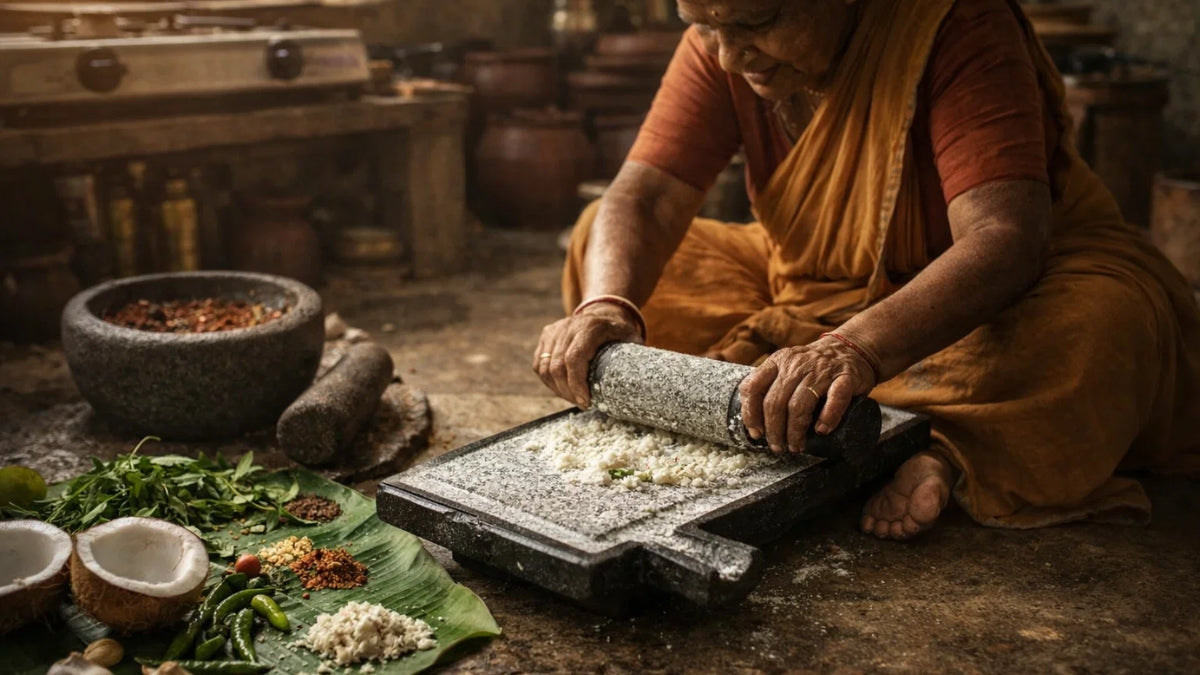
I’ll be honest, this is something I understood only after comparing side by side.
Same chutney. Same ingredients. One made in a mixer, the other on an Ammikal.
The difference? Not small.
The one from the mixer was fine, smooth, quick, and convenient. But the one from the ammikal… it had a body. Texture. A kind of depth that made you go for a second serving without even thinking.
That’s when it clicked: traditional kitchenware isn’t just about nostalgia. It actually changes how food tastes.

It’s Not Grinding, It’s Crushing
The biggest difference starts here.
Modern mixers use sharp blades that spin fast. They cut ingredients aggressively. In seconds, everything turns into a smooth paste.
But tools like the Aatukal or ammikal don’t cut, they crush.
You apply pressure. You move slowly. The ingredients break down naturally.
Because of that:
-
Flavors release gradually
-
Oils from spices and herbs come out gently
-
Nothing gets overheated
And that last point matters more than we think.
No Heat = Better Flavor
Have you ever noticed how mixer chutney sometimes tastes slightly… flat?
That’s often because of heat.
High-speed blades generate heat while grinding. It’s not something we see, but it’s there. And that heat can dull the freshness of ingredients, especially things like coconut, coriander, mint, and garlic.
With an ammikal or Nanni Kalvam, there’s no heat buildup.
Everything stays cool. Fresh. Alive.
So when you taste the chutney or masala, the flavors feel sharper and more natural.
Texture Changes Everything
This is where traditional tools really stand out.
Mixer chutney is usually very smooth. Almost too smooth.
But chutney from an ammikal? It has a slight grainy texture. Not rough, just enough to feel each ingredient.
That small difference changes how it tastes.
-
Coconut feels richer
-
Chillies hit differently
-
Ginger and garlic stand out better
Even simple idli chutney becomes more satisfying.
The same goes for masalas ground in a nanni kalvam; you can actually feel the spice blend, not just taste it.
Stone Adds Something Subtle
This is hard to explain unless you’ve grown up with it.
Food ground on stone has a very faint, natural depth. Not a strong flavor, but something in the background that makes it taste more “complete.”
It’s especially noticeable in:
-
Coconut chutney
-
Idli podi mixes
-
Fresh masalas
When you switch back to mixer versions after that, something feels missing. You may not name it, but you’ll notice it.
Slower Process = Better Blending
Using an ammikal or aatukal takes time. There’s no shortcut.
At first, it feels like extra effort. Your hands get tired. You wonder why you didn’t just use the mixer.
But as you keep grinding, something interesting happens: the ingredients start blending more naturally.
Instead of becoming a paste instantly, they slowly come together. The salt mixes evenly. The spice balances out.
And the final result? Much more harmonious.
Aroma Hits Different
This is something I didn’t expect.
When you grind chutney or masala on a stone, the aroma is stronger. Fresher.
You can actually smell:
-
The coconut releasing its sweetness
-
The curry leaves are opening up
-
The garlic is becoming sharp and rich
In a mixer, a lot of this happens too quickly or gets slightly muted due to heat.
But with traditional tools, the aroma builds slowly… and stays.
Small Quantities, Big Impact
One underrated advantage of tools like Nanni Kalvam is the control they offer.
You don’t need to make a big batch. You can grind just enough for one meal.
Fresh masala, freshly crushed pepper, and ginger-garlic paste, made right before cooking.
And that freshness? It shows in the taste immediately.

It Makes You More Involved
Let’s be real, using a mixer is convenient, but it disconnects you from the process.
You add ingredients, press a button, and walk away.
With an ammikal or aatukal, you’re fully involved.
-
You control the pressure
-
You decide the texture
-
You adjust as you go
You’re not just preparing food, you’re making it.
And somehow, that effort reflects in the final dish.
There’s Also a Memory Factor
For many of us, these tools remind us of home.
Grandmothers sitting on the floor, slowly grinding chutney. The sound of stone. The smell of fresh masala.
That connection adds something emotional to the food.
Even if the recipe is simple, it feels richer, more comforting.
And yes, that also plays a role in why it tastes better.
Is It Practical Today?
Let’s be honest, not everyone has the time to grind everything by hand daily.
And that’s okay.
You don’t have to replace your mixer completely.
Instead, try this:
-
Use an ammikal for chutneys on weekends
-
Use nanni kalvam for small spice blends
-
Try aatukal for special dishes
Even occasional use makes a noticeable difference.
Final Thought
Traditional kitchenware like ammikal, aatukal, and nanni kalvam aren’t just old tools; they’re a different way of cooking. A slower way. A more connected way. And most importantly, a way that brings out flavors you didn’t even realize were missing.
Once you taste that difference, even once, it’s hard to ignore.
You might still use your mixer every day. But you’ll always know what you’re missing.


